

Menu of ideas for preventive health action
Be inspired with actions your council can take to improve the health and wellbeing of your community. Start with some 'quick wins' while you work towards more long lasting change.
Many ideas listed have intersectionality and address more than one community wellbeing topic. New ideas will be added regularly.
You can view the menu of ideas (on this page) or download the menu of ideas (PDF 4.6 MB).
Partner with Preventive Health SA
Preventive Health SA can help deliver your preventive health project. They offer mentoring, access to data and resources, expert guidance and program evaluation support.
To express your interest in partnering with Preventive Health SA, email: preventivehealthsa.strategy@sa.gov.au.
You may also like to look through the list of networks, data, stakeholders, and resources.
Menu of ideas
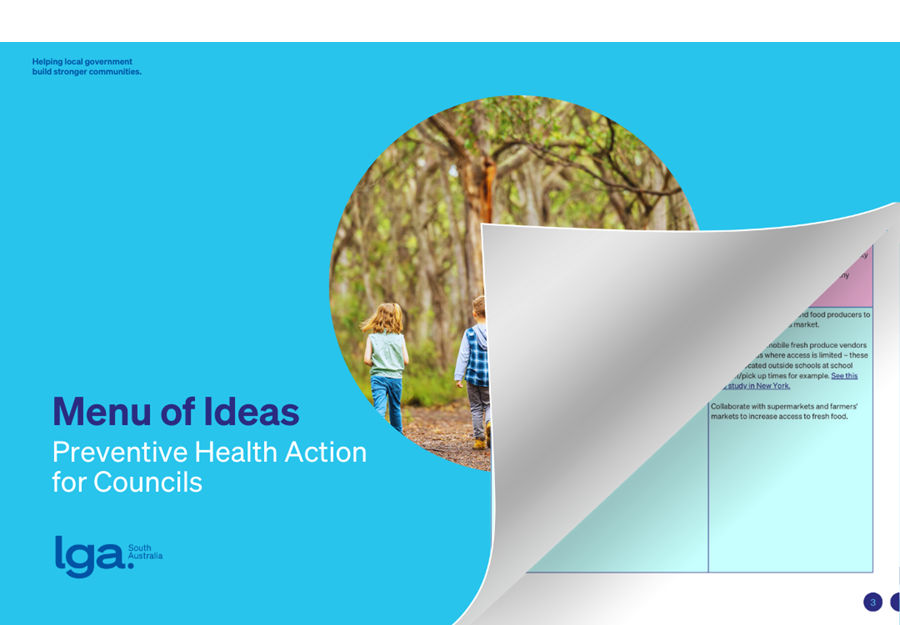
Read through the menu of ideas below, which includes:
- Short-term 'quick wins' that focus on immediate community impact through raising awareness and providing support.
- Long-term project ideas that may require systemic change, infrastructure investment and/or policy reform to create sustainable health improvements.
You can also download the menu of ideas (PDF 4.6 MB).
Creating healthy food environments
- Healthy environments Healthy environments
- Programs and events Programs and events
- Policies and procedures Policies and procedures
- Promotion and communication Promotion and communication
- Partnerships and stakeholders Partnerships and stakeholders
Short-term
- Install water refill stations in parks and public spaces to promote water consumption over sugary drinks.
Long-term
- Establish community gardens for fresh food produce and community connection.
- Offer safe spaces for breast feeding in council offices and buildings.
Short-term
- Establish community fruit and vegetable swap groups which allow residents to share and swap home grown produce.
- Offer food education workshops or programs to the community.
- Run a community event related to specific culture and cuisine.
- Provide healthy food options and free drinking water at council-run events.
- Consider starting up a social supermarket.
- Encourage people to grow their own food through gardening initiatives such as Grow it Local.
Long-term
- Introduce a policy that embeds wellbeing criteria in council grants, such as making sure grant funded activities don't promote, advertise and/or endorse unhealthy food and drinks.
- Introduce healthy catering guidelines for council-run events.
- Introduce policy for healthy vending machine options (PDF 1.2 MB) in council offices and buildings.
- Create healthy advertising standards (PDF 1.6 MB) or a policy that prevents unhealthy food and drink advertising (including alcohol) on council-owned or run assets and spaces, this could also include sponsorship of events.
- Introduce a breastfeeding friendly policy such as Breast Feeding Australia’s Breast Feeding Friendly Workplaces program.
Short-term
- Promote the BYOB (bring your own bottle) app through social media and communication channels to spread awareness of opportunities to fill up your water bottle in public spaces.
- Promote breastfeeding through signage and other means.
- Provide information on council webpages about topics such as local produce, gardening and local markets.
Short-term
- Work with local cafes to promote healthier menu options.
- Choose food vendors who offer healthy food options at council run events.
- Partner with OzHarvest to reduce food waste and run nutrition and food literacy education sessions in the community.
- Partner with schools and preschools to implement heathy eating education.
- Work with sporting clubs and other community groups to encourage healthy food environments, including sourcing healthy rewards options.
Long-term
- Parter with local famers and food producers to establish a local farmers market.
- Issue permits to mobile fresh produce vendors in priority areas where access is limited – for example, these could be located outside schools at school drop-off and pick up times. See the Green Carts case study in New York.
- Collaborate with supermarkets and farmers' markets to increase access to fresh food.
Supporting physically active communities
- Healthy environments Healthy environments
- Programs and events Programs and events
- Policies and procedures Policies and procedures
- Promotion and communication Promotion and communication
- Partnerships and stakeholders Partnerships and stakeholders
Short-term
- Investigate the accessibility of parks, playgrounds and open spaces in your council area.
- Provide access to courts or sporting fields to the public out of hours (for example, basketball, tennis, netball courts, soccer, football fields). This may involve installing timed lights to enable after dark access.
- Install wayfinding signage and maps in existing parks and open spaces to highlight and guide community through walking and cycling trails.
Long-term
- Establish an Active Streets program which seeks to promote safe walking/cycling routes to schools, workplaces, and shops.
- Upgrade walking paths to be safer, more inclusive and to connect community spaces such as parks and playgrounds.
- Create more shaded areas along walking trails and seating in parks.
- Upgrade parks and playgrounds to entice community members.
- Establish dedicated dog parks.
- Invest in planting more trees and protecting existing trees on residential property and council owned land.
- Make sure park benches and street furniture are inclusive of design elements to support all community members (for example, they include arm and back rests).
- Design spaces that follow the healthy active by design for SA guide (PDF 12 MB). This, and other useful resources, can be found on the Heart Foundation's healthy active by design website.
Short-term
- Become a host for a Heart Foundation walking group in your council.
- Establish local walking groups.
- Offer fitness classes at local parks and open spaces.
- Start a walking netball or soccer competition at local courts and fields.
- Explore Our Big Backyard’s free resources which include tools and an activity pack to connect people and children with local natural places.
- Implement the 6-Steps for Councils to Promote Outdoor Fitness Equipment in SA (PDF 527 KB).
- Offer chair-based strength training programs.
- Consider waiving or offering discounted permit fees for use of council land for free community yoga and other group fitness programs.
- Deliver walking and riding to school programs and promote the Cycle Instead Journey Planner.
Long-term
- Create a nature play program.
Short-term
- Implement a Healthy Workplace Policy that encourages walking meetings, standing at desks.
Long-term
- Embed Active Transport Policies into urban planning (for example, require footpaths in all new developments).
- Develop a Physical Activity Strategy for the council, with measurable targets.
Short-term
- Promote the Heart Foundation Walking program.
- Promote Ride2School Day and Ride2Work Day.
- Create a campaign to showcase local physical activity opportunities.
- Develop a year-round physical activity calendar, with diverse events for all ages and abilities.
- Create and promote a physical activity map for your council area, highlighting walking trails, pools, parks, playgrounds, outdoor gyms, and green and blue spaces for activation.
- Register your parks and playgrounds on the Playground Buddy app and promote this to community members.
- Display Healthy workplaces stretching and activities posters in councils offices and buildings.
- Promote the LiveLighter Being Active resources to community, including the free workout plans and physical activity calculator.
- Participate in and promote the 10,000 steps program via social media and communication channels. Register with 10,000 steps to access resources to promote in your community.
Long-term
- Promote large-scale 'Move More, Sit Less' campaigns.
Short-term
- Partner with the Department for Infrastructure and Transport on the Way2Go initiative to create and promote safe routes for children and families to take active transport to school.
Long-term
- Work with local schools and sporting clubs to improve access to open public green and blue spaces (PDF 1.8 MB) or unorganised sport and recreational physical activity.
- Partner with hospitals and GPs to introduce exercise referral programs (social prescribing) for patients for council run events.
- Work in partnership to create better active transport routes connecting communities to parks, playgrounds and spaces for physical activity.
- Partner with Our Big Backyard to deliver a project activating natural spaces in your community.
Alcohol and other drugs
- Healthy environments Healthy environments
- Programs and events Programs and events
- Policies and procedures Policies and procedures
- Promotion and communication Promotion and communication
- Partnerships and stakeholders Partnerships and stakeholders
Short-term
- Create a safe and healthy workplace environment within the local council that addresses alcohol related issues and associated harms. Use the healthy workplace toolkit (PDF 1.9 MB) (alcohol section) and alcohol resource referral guide (DOCX 461 KB) with a list of sample strategy actions in the workplace.
Short-term
- Offer information session for parents on how to have conversations with teenagers about alcohol and other drugs through council run sporting precincts or other council run facilities/initiatives.
- Offer community-based alcohol and drug education sessions.
Long-term
- In consultation with staff, develop workplace alcohol and drugs policy as part of work health and safety systems in preventing alcohol and other drugs related risks. Use the National Centre for Education and Training on Addiction’s alcohol and drug policy template (PDF 181 KB) and alcohol and drug policies factsheet (PDF 572 KB) for guidance.
Short-term
- Deliver community awareness campaign about staying alcohol-free during pregnancy, when planning pregnancy or breastfeeding aimed at women of childbearing age and their partners. Check Every Moment Matters for links to resources.
- Run a Don’t Let Meth Take Hold campaign to increase knowledge and awareness about the impacts of methamphetamine, also known as ice, crystal or speed, on physical and mental health.
- Embed non-stigmatising messaging in council communications in addressing alcohol and other drugs issues in the community. Refer to The Power of Words from Alcohol and Drug Foundation, or VicHealth’s values-based messaging for health promotion to stop or reduce drinking alcohol.
- Promote NHMRC alcohol guidelines on standard drink of alcohol and its impacts on health, safety and wellbeing.
- Promote the awareness of programs and support services in South Australia to make informed decisions on preventing or reducing alcohol and drugs uptake such as:
- Alcohol and Drug Information Service (ADIS) on 1300 13 1340
- Know Your Options
- ASSIST digital screening tools – for people to check their risk of AOD use and seek help early.
Long-term
- Develop and implement sustainable public campaigns to increase awareness and knowledge, and shift behaviours in preventing or reducing alcohol and other drugs use.
Short-term
- Partner with local First Nations community organisations, such as Aboriginal Community Controlled Health Organisations (ACCHOs), in developing culturally appropriate prevention programs or initiatives in addressing alcohol and other drugs. Find an ACCHO near your council.
- Partner with non-government organisations like Cancer Council SA, Alcohol and Drug Foundation or the South Australian Network of Drug and Alcohol Services in running presentations or trainings about preventing or delaying initiation of alcohol and other drugs use for staff working with children and young people.
Long-term
- Work with health services to integrate referral pathways for early intervention and support services on alcohol and other drugs. Visit the Know Your Options services directory for a list of services in your local area.
- Partner with local community organisations in developing a whole of community place-based response in addressing alcohol and other drugs issues in the community.
Smoking and vaping
- Healthy environments Healthy environments
- Programs and events Programs and events
- Policies and procedures Policies and procedures
- Promotion and communication Promotion and communication
- Partnerships and stakeholders Partnerships and stakeholders
Short-term
- Increase signage in public spaces to promote smoke-free and vape-free areas.
Long-term
- Identify and consider creating declared smoke-free and vape-free outdoor public areas and events, short term and/or long term.
Short-term
- Offer smoking and vaping cessation workshops.
- Offer education sessions on smoking and vaping for youth and parents.
Long-term
- Embed smoking and vaping restrictions into urban planning, ensuring that high-traffic community areas remain smoke-free.
Short-term
- Amplify messaging and circulate resources about tobacco and vaping harms during the Quit Your Way in May campaign.
- Promote smoke-free vape-free outdoor areas laws using Clearing the Air information and free signage options.
Long-term
- Partner with Alcohol and Drug Foundation and Planet Youth to implement a long-term program for tobacco, vaping, alcohol and drug use prevention.
Mental wellbeing
- Healthy environments Healthy environments
- Programs and events Programs and events
- Policies and procedures Policies and procedures
- Promotion and communication Promotion and communication
- Partnerships and stakeholders Partnerships and stakeholders
Short-term
- Create and designate mentally healthy public spaces to promote conversations about mental health activities.
Long-term
- Prioritise creating quiet, green spaces in public areas for relaxation and social connection by embedding mental health into urban planning.
- Develop sensory gardens, reflective spaces, and shaded areas for relaxation.
- Include yarning circle areas in public parks and playgrounds.
Short-term
- Offer free guided community mindfulness, meditation or yoga sessions.
- Establish Happy to Chat or a chatty bench.
- Host an intergenerational event or program like GRANDfriends or intergenerational playgroup.
- Host a mindful art sessions.
- Offer guided nature walks.
Long-term
- Offer social and mental health support by hiring and posting trained social workers in libraries or community centres.
Short-term
- Conduct a self-assessment of council action on the determinants of mental wellbeing.
- Offer mental health training for council staff and community leaders.
- Foster collaboration and partnership within and across activities that have an impact on mental wellbeing (for example, programs that support action on bullying and discrimination, gender equity, safe relationships etc.).
Long-term
- Adopt a 'Thriving Communities' strategy, embedding mental health considerations in urban planning.
Short-term
- Participate in mental health campaigns such as RU OK? Day.
- Compile and distribute resources or a list of mental health services available in your council area.
- Create a communication package of mental wellbeing messages and actions staff and community can undertake.
Short-term
- Create a mental wellbeing action group with community members and staff.
- Work with local businesses to implement mental wellbeing workplace initiatives.
- Partner with the Department of Human Services to implement the Community Connections program.
Long-term
- Partner with hospitals and GPs to introduce social prescribing for council programs to patients.
- Partner with mental health institutes such as Headspace, Lifeline or Black Dog Institute to explore long term mental health and suicide prevention projects.
Suicide prevention
- Healthy environments Healthy environments
- Programs and events Programs and events
- Policies and procedures Policies and procedures
- Promotion and communication Promotion and communication
- Partnerships and stakeholders Partnerships and stakeholders
Short-term
- Undertake an audit of council area to identify any locations of increased risk of suicide harm.
Short-term
- Create events for World Suicide Prevention Day (10 September each year).
- Support Suicide Prevention Network events in each Council region.
Short-term
- Develop a pyscho-social hazards policy for staff.
- Develop a charter committing to challenging stigma and discrimination of all kinds.
- Offer accidental counsellor or compassionate foundations training to all front facing staff.
Long-term
Develop a Suicide Prevention Action Plan (PDF 203 KB) – adopt a comprehensive multi-year strategy in alignment with national/state frameworks.
Short-term
- Use the mindframe guidelines for safe communication about suicide.
- Create a list of key helpline and active support services for in your community. Include Suicide Prevention Network if appropriate.
- Have regular columns which allow groups to promote evidence-based information about suicide prevention.
Long-term
- Sign the National Communications Charter on discussion of mental illness and suicide.
Short-term
- Partner with your local Suicide Prevention Network. If there isn’t one in your area, consider establishing one, partnering with Preventive Health SA.
- Collaborate with local mental health services to create 24/7 crisis support safe spaces.
- Provide practical support to Suicide Prevention Networks (SPNs) such as:
- promoting their activities or events
- supporting member recruitment and retention
- prioritise the SPN for grants.
- Provide subsidised or free venue hire, offer advertising in local newsletters, printing of flyers etc.
Determinants of health
- Healthy environments Healthy environments
- Programs and events Programs and events
- Policies and procedures Policies and procedures
- Promotion and communication Promotion and communication
- Partnerships and stakeholders Partnerships and stakeholders
Short-term
- Establish digital literacy workshops and support for the community.
- Participate in LGBTIQA+ Training to improve safety of your organisation for employees and community members. Different options are available from providers such as SHINE SA, COTA SA or Bfriend. Free Equity in Action: LGBTIQA+ Awareness Training is available through Shine SA until December 2026.
- Fly the rainbow or trans flag from council buildings on LGBTIQA+ awareness days.
Long-term
- Create cooling and greening projects to increase tree canopy, shaded seating, and green roofs to reduce urban heat.
- Evaluate public transport routes for better access to shops, banks, open public spaces, and recreation centres for disadvantaged communities.
Short-term
- Consider accessibility when planning programs and events. This could include (but is not limited to) providing low sensory spaces, making sure spaces and toilets are wheelchair accessible, or considering Covid-19 safety for the benefit of all attendees.
- March at the state Pride March under a council banner.
- Run free financial literacy and job readiness workshops for vulnerable groups or offer them online – for example City of Playford's Everyday Money Skills.
- Participate in and/or fund artists to participate in Feast Festival, SA’s LGBTIQA+ arts and cultural festival.
- Offer rebates for the planting of trees, such as the City of Charles Sturt’s tree rebate scheme (Treebate).
Long-term
- Join the Multicultural SA Ambassador Program to be supported to identify targeted, realistic and achievable actions to implement the principles of the SA Multicultural Charter (PDF 401 KB).
- Provide information to residents on local tree canopy to build awareness about the value of trees (economic and environmental). Include tree canopy information in rates notices like the City of Unley.
- Include signage on trees to provide information on their importance, for example City of Prospect's City of Prospect’s Tree Tags.
- Create and share a tree map that residents can add to when they plant a shade-creating tree, for example the City of Port Adelaide Enfield’s Get Shady program.
Short-term
- Place cultural diversity at the heart of decision making by using the SA Multicultural Charter Guide (PDF 511 KB) to embed/support the South Australian Multicultural Charter.
Long-term
- Create liveable cities by implementing mixed-use development plans to ensure access to affordable housing, employment, transport, and green spaces.
- Prioritise social housing in council planning frameworks, for example City of Adelaide’s Homelessness Strategy (PDF 30.5 MB).
- Get involved in the Rainbow Council Project through the South Australian Rainbow Advocacy Alliance and initiate projects such as:
- making sure council services are LGBTIQA+ inclusive
- undertaking Rainbow Tick accreditation or a similar accreditation program for council run services
- passing motions to support LGBTIQA+ equality
- training staff on LGBTIQA+ equality and inclusion
- providing all gender toilets and change rooms at public and sporting facilities.
- Develop a Tree Canopy Improvement Strategy or Urban Greening Strategy to increase tree canopy cover, increase the public value of trees, and encourage planting and retention of trees on public and private land.
Short-term
- Publicly support diversity, equity and inclusion.
- Make public statements in support of trans and gender diverse people in your local community. You may wish to participate in the Rainbow Council Project.
- Develop a communications plan for significant events. You may wish to use Diversity Council Australia’s calendar of events. This can be a way to show your support for different groups of people, especially those that may be marginalised by systems.
Short-term
- Undertake inclusive community engagement. Tips to better engage people with disability are available from The Local Government Disability Inclusion Advisory Group.
Long-term
- Formal collaboration with state and federal governments to address housing affordability and social determinants of health.
Aboriginal health and health equity
- Health environments Health environments
- Programs and events Programs and events
- Policies and procedures Policies and procedures
- Promotion and communication Promotion and communication
- Partnerships and stakeholders Partnerships and stakeholders
Short-term
- Fly Aboriginal and Torres Strait Islander flags.
Long-term
- Display Aboriginal branding and artworks.
Short-term
- Hold events for National Reconciliation Week and NAIDOC Week.
- Offer training about cultural safety and respect.
Short-term
- Buy from Aboriginal-owned businesses. As a starting point, you could look at the SA Aboriginal business directory.
- Include Acknowledgement of Country statements into official meetings, gathering and events.
Long-term
- Begin or progress your council’s Reconciliation Action Plan journey to improve outcomes for your council's First Nations communities.
Short-term
- Develop a communications plan for significant events. You may wish to use Diversity Council Australia’s calendar of events.
Long-term
- Consider partnering with Aboriginal Community Controlled Organisations and Aboriginal Community Controlled Health Organisations.
Webinar recording
Watch our webinar recording to learn more about the menu of ideas and how to use this resource.
Find out more
For more information, please contact:
Preventive Health SA
Strategy and Partnerships
Email: preventivehealthsa.strategy@sa.gov.au