Climate risk assessment & planning
Governments today are at risk of legal and financial liabilities if they fail to adequately consider climate change risk in their planning and decision making.
Climate change risk and community support must be considered by governments when planning for the future. This includes physical, financial, legal, and transitional risks.
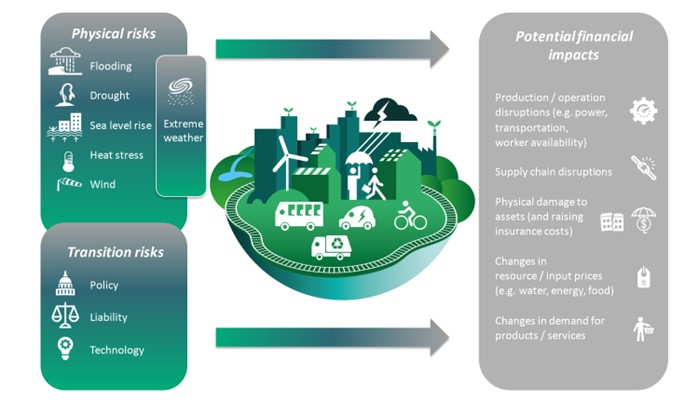 Government agencies that fail to mitigate, manage and disclose climate risks in their governance and decision-making will expose themselves to legal liabilities and litigation as both an actor and a regulator, in legislation, policy and delivery. The Climate Council recently released the Neighbourhood Issue: Climate risks and costs to Councils report, which provides further context and case studies on this issue.
Council and Climate Risk
We asked councils why it's important to manage climate risks. This is what they said.
Climate Risk Training and Engagement Package
A suite of training and engagement tools to raise awareness within senior levels of councils regarding climate risk management has been developed by the LGA for South Australian councils. This is a complete set of materials for use by council staff who want to deliver this message to key decision makers of councils, including executive staff and Elected Members (and Audit Committee members). Benefits of using these training materials include:
- a consistent approach to climate risk training across councils
- highlight the latest risk frameworks for climate change impacts (ie including physical, transitional, legal and financial risks)
- links to processes and guides for the management of strategic and operational climate risk with local government.
These resources were developed by consultants BRM Advisory, with funding provided via the Local Government Research & Development Scheme and Resilient East.
Training modules and case studies
The modules below link to a downloadable files for
- the core training modules (presentation slides and speaker notes)
- facilitator guide (introduction to the modules and case studies, how they are to be used and tips on how to engage with your audience)
- a self-assessment questionnaire.
How to use the additional resources
This 9 minute video explains how to use the additional resources such as the facilitator guides and self-assessments.
The Hot Seat Game is an interactive workshop activity designed to enhance climate risk training materials.
It puts participants in the decision-making 'hot seat' within various climate risk scenarios. During the workshop, participants assume different key stakeholder roles, including the primary decision maker in the 'hot seat'.
This activity can be integrated into climate risk training or conducted as a standalone exercise.
Guide to climate projections for risk assessment and planning in South Australia
This Guide to Climate Projections for Risk Assessment and Planning in South Australia provides a summary of the likely changes to key climate variables such as temperature, rainfall, evapotranspiration, days of severe fire danger and sea level rise, under different greenhouse gas emissions scenarios. The document draws on the most up-to-date climate change projections for South Australia and can be used for climate change risk assessment, adaptation planning and community engagement.
Climate Risk and Opportunity Management Program (CROMP)
The Commonwealth Department of Climate Change, Energy, the Environment and Water (DCCEEW) have developed a set of guides and templates for assessing, managing, and disclosing climate risks. These guides are to assist all levels of government (Federal, State, and local).
The web-based Climate Risk Digital Tool guides users through the process of undertaking a climate risk and opportunity assessment in accordance with the CROMP framework.
A set of documents have been developed as a part of the CROMP that may be useful for other level of government, including using councils even though these were developed for Commonwealth agencies, The key resources are;
- Climate Risk Management: The Australian Government’s Approach to Climate Risk and Opportunity Management - An outline of the overall approach to Climate Risk Management for Commonwealth Agencies.
- Climate risk management organisation application guide - A guide to identify, assess and manage climate risks for an organisation or part thereof.
- Climate Risk Management Program Project Policy Application Guide - A guide to identify, assess and manage climate risks for a specific project.
- Climate Risk Management Technical Guidance - A detailed, advanced guide for focused assessment (to be used in conjunction with the two application guides).
- Climate Risk Management template (Excel Spreadsheet)
Access all Climate Risk and Opportunity Management Program resources
Cost-Benefit of Adapting to Climate Change - Victorian Greenhouse Alliances
The metropolitan Victorian Greenhouse Alliances, coordinated by NAGA, have just delivered a scoping study investigating the costs and benefits of climate change adaptation options for councils managing community assets. This project was designed to assist councils across the Greater Melbourne region, and was supported by the Department of Environment, Land, Water and Planning (DELWP) through the Supporting our Regions to Adapt program.
The final research report and Cost-Benefit Analysis Framework are useful guides for councils conducting their own cost-benefit analyses. A webinar sharing the final outcomes of this project in November 2021 is available.
- Part 1: Overview of the findings, outcomes and cost-benefit analysis framework
- Part 2: A deep-dive into a worked example using the cost-benefit analysis framework
How well are we adapting? Victoria
The How Well Are We Adapting (HWAWA) network, coordinated by the Western Alliance for Greenhouse Action has developed an Adaptive Capacity Checklist for councils
Queensland Climate Resilient Councils (QCRC) Portal
The Queensland Climate Resilient Councils (Q CRC) program is working with Queensland local governments to deliver services and products that will strengthen staff and leadership team skills and capacity to plan for and respond to the challenges and opportunities arising from climate change.
Climate Change Action Framework (WALGA)
The Western Australia LGA's Climate Change Action Framework sets out a logical sequence of steps that Local Governments can follow to respond to climate change. The framework is intended to guide both Local Governments that are commencing their climate change journey, and those that are well progressed and are strengthening their approach.'